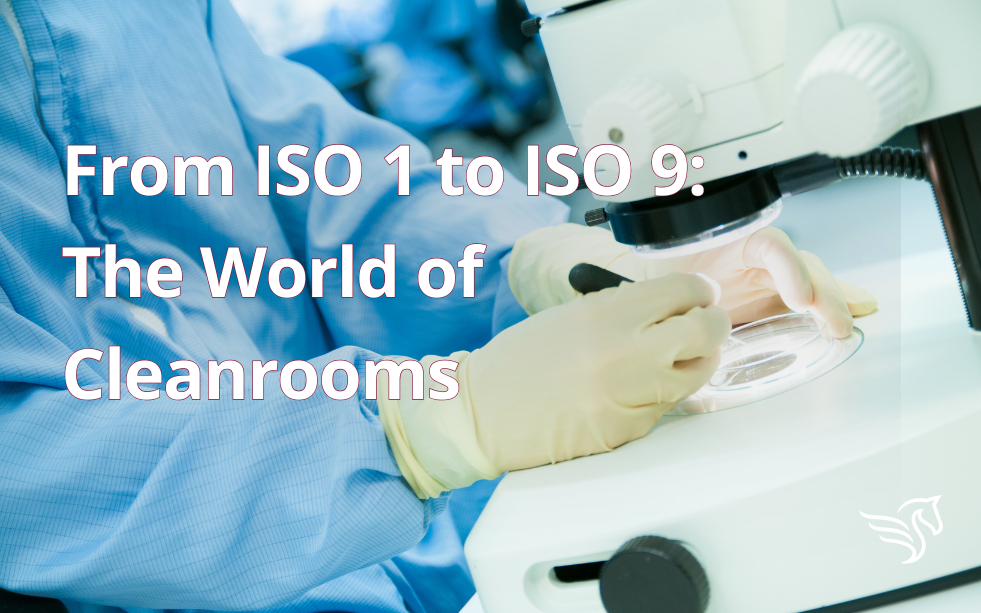
Did you know some cleanrooms are clean enough to support work involving equipment destined for space? We’ll dive into some interesting facts about the rarest cleanroom classification, ISO Class 1, toward the end of this overview.
How Do Cleanrooms Work?
Any process that can be affected by airborne particles or contamination may benefit from a cleanroom or controlled environment. Cleanrooms are commonly used in industries such as pharmaceutical manufacturing, biotechnology, life sciences, semiconductor manufacturing, medical device production, aerospace, and other highly controlled applications.
Cleanrooms use filtration and carefully controlled airflow to reduce airborne particles within the space. Depending on the cleanroom design and application, filtered air may be recirculated through the room or exhausted from the environment.
The level of contamination control required varies considerably depending on what takes place within the room.
In addition to controlling airborne particles, cleanroom systems may regulate several other environmental properties, including:
- Temperature
- Humidity
- Airflow
- Filtration
- Pressure
For facilities operating controlled environments, maintaining these conditions requires more than ordinary janitorial cleaning. Cleanroom cleaning programs must be designed around the facility’s classification, processes, contamination risks, and established protocols.
Cleanroom ISO Classifications
The International Organization for Standardization, or ISO, develops standards used across industries around the world.
Cleanroom air cleanliness is addressed by ISO 14644-1, which classifies cleanrooms and clean zones based on the concentration of airborne particles.
ISO 14644-1 establishes classifications ranging from ISO Class 1 through ISO Class 9. ISO Class 1 represents the most stringent particle concentration limits, while ISO Class 9 allows substantially higher airborne particle concentrations.
The classification is based on the maximum allowable concentration of particles equal to or larger than specified particle sizes within a cubic meter of air.
The appropriate ISO classification depends on the processes being performed and the contamination-control requirements of the facility.
For organizations in biotech, life sciences, pharmaceutical, and GMP environments, these classifications may form one part of a much broader contamination-control and facility-management program.
Deep Dive: ISO Class 1 Cleanrooms
It’s not an exaggeration to say ISO Class 1 cleanrooms belong to a very exclusive group.
ISO Class 1 cleanrooms are designed for highly specialized processes that require extraordinarily low concentrations of airborne particles. Applications can include advanced scientific research, nanotechnology, specialized electronics, aerospace, and other processes where extremely small particles can interfere with the work being performed.
One example comes from the European Space Agency. ESA operates an ISO Class 1 ultra-clean microbiology laboratory in Noordwijk, the Netherlands. The facility has been used for planetary protection procedures, including examination of temperature sensors destined for the surface of Mars.
ISO Class 1 Cleanroom Requirements and Standards
ISO Class 1 represents the strictest airborne particle concentration classification within ISO 14644-1.
Under ISO 14644-1:2015, the selected particle concentration limits for ISO Class 1 include no more than:
- 10 particles per cubic meter at 0.1 micrometers and larger
- 2 particles per cubic meter at 0.2 micrometers and larger
ISO does not establish a 0.3-micrometer classification limit for ISO Class 1 because particle concentrations at that size become too low for appropriate classification using the standard’s sampling methodology.
The numbers illustrate just how tightly controlled an ISO Class 1 environment must be.
The European Space Agency describes the air in its ISO Class 1 cleanroom as containing millions of times fewer particles than the outside atmosphere when the room is at rest.
Maintaining an environment at this level requires carefully engineered filtration and airflow systems combined with rigorous procedures for personnel, gowning, material movement, equipment, cleaning, and contamination control.
Establishing Cleanroom Cleaning Processes Is Vital
Most facilities do not operate an ISO Class 1 environment. However, every controlled environment needs cleaning procedures appropriate to its classification, operation, and contamination-control requirements.
Maintaining those conditions requires a cleaning process that is systematic, repeatable, and consistent.
Without clearly defined procedures, facilities can face problems such as:
- Failed audits or quality checks
- Increased contamination risk
- Process or product failures
- Inconsistent cleaning between technicians or shifts
- Documentation gaps
- Difficulty maintaining required environmental conditions
Cleaning a cleanroom is also very different from ordinary commercial cleaning.
Cleanroom personnel must understand requirements such as gowning and entry procedures, contamination-control practices, approved chemicals and supplies, directional cleaning, proper use of HEPA or ULPA-filtered equipment, documentation, and facility-specific standard operating procedures.
Protect Your Controlled Environment With Specialized Cleanroom Cleaning
Cleanrooms are engineered to control contamination, but maintaining those conditions depends on consistent execution.
Pegasus provides specialized cleanroom cleaning services for cleanrooms, laboratories, GMP facilities, gown rooms, gray spaces, and other critical environments. Cleaning programs are developed around the facility’s requirements, workflows, and contamination-control protocols.
Need support maintaining your cleanroom or controlled environment? Request a cleanroom cleaning quote from Pegasus.
Frequently Asked Questions About ISO Cleanroom Classifications
What are the ISO cleanroom classifications?
ISO 14644-1 classifies cleanrooms from ISO Class 1 through ISO Class 9 based on allowable concentrations of airborne particles. ISO Class 1 has the most stringent particle limits, while ISO Class 9 allows higher particle concentrations.
What is the cleanest ISO cleanroom classification?
ISO Class 1 is the most stringent air cleanliness classification included in ISO 14644-1. It permits a maximum of 10 particles per cubic meter at 0.1 micrometers and larger and 2 particles per cubic meter at 0.2 micrometers and larger.
What standard defines ISO cleanroom classifications?
Cleanroom classification by airborne particle concentration is defined in ISO 14644-1, Cleanrooms and associated controlled environments, Part 1: Classification of air cleanliness by particle concentration.
What is the difference between ISO Class 1 and ISO Class 9?
The primary difference is the concentration of airborne particles permitted within the environment. ISO Class 1 has extremely restrictive particle concentration limits and is used for specialized applications requiring exceptional contamination control. ISO Class 9 permits much higher concentrations and represents the least restrictive classification within the ISO 14644-1 system.
Does ISO classification determine how a cleanroom should be cleaned?
The ISO classification helps establish the cleanliness level that must be maintained, but cleaning procedures should also account for the facility’s processes, contamination risks, equipment, regulatory requirements, SOPs, and operating conditions. Cleanroom cleaning programs should therefore be developed specifically for the environment rather than relying on a single generic procedure.
Why does cleanroom cleaning require specialized training?
People, equipment, materials, and cleaning activities can all introduce or redistribute contamination. Personnel working in controlled environments need to understand facility-specific requirements such as gowning, entry and exit procedures, approved equipment and chemicals, directional cleaning, contamination-control practices, and documentation.