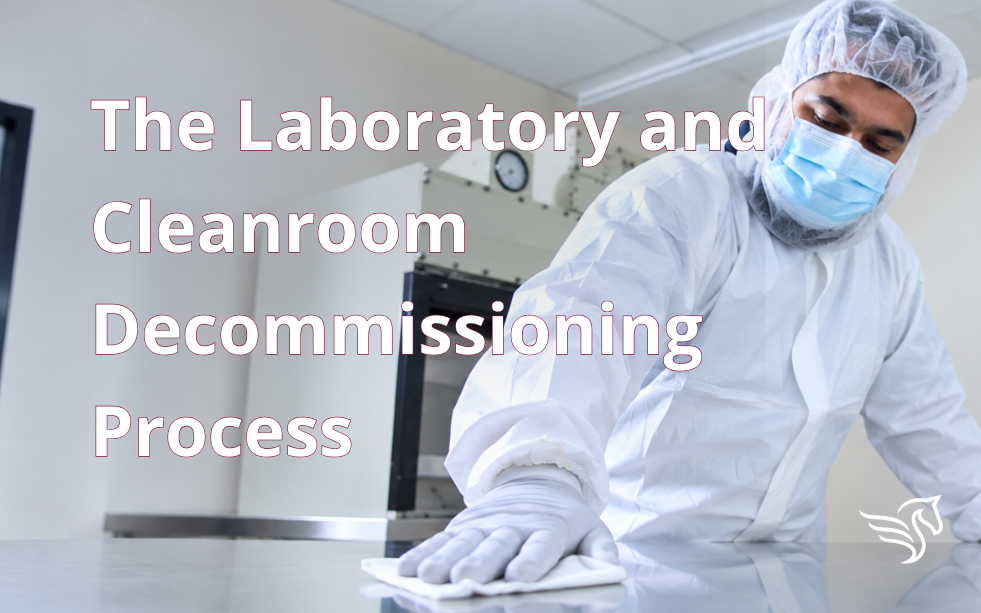
These environments may have supported years of work involving chemicals, biological materials, specialized processes, controlled airflow, sensitive equipment, and strict contamination-control procedures. Even after operations have stopped, residues or contamination may remain on equipment, work surfaces, casework, floors, walls, utility connections, exhaust components, and other areas of the facility.
That is why laboratory and cleanroom decommissioning should be treated as a coordinated process rather than a final cleaning appointment.
The exact process will vary based on the facility, its historical use, the hazards involved, and what will happen to the space next. However, most successful decommissioning projects move through the same general stages.
Step 1: Define the Project and the Required End State
Before any cleaning or equipment removal begins, the project team should establish what decommissioning means for that particular space.
Is the laboratory being:
- Vacated at the end of a lease?
- Relocated to another facility?
- Renovated for a new research program?
- Converted to general office or manufacturing space?
- Prepared for demolition?
- Transferred to another tenant or department?
- Taken out of service permanently?
The intended end state of the space matters because it helps determine the scope of cleaning, decontamination, equipment handling, verification, and documentation.
For example, preparing a laboratory for another scientific tenant may require a different turnover process than preparing the same room for demolition.
At this stage, facility management, environmental health and safety (EHS), laboratory leadership, quality teams, property management, and specialty contractors should identify responsibilities and establish the sequence of work.
This is also when the critical-cleaning provider should be involved. Bringing the cleaning team, like Pegasus, into the project early on in the process can help uncover access requirements, contamination concerns, equipment dependencies, and verification expectations before they affect the schedule.
Step 2: Review Historical Use and Identify Potential Contamination
A room that appears empty can still contain contamination associated with its previous use.
The project team should review what processes occurred within the space and identify materials that may have contacted:
- Benchtops and laboratory casework
- Floors and walls
- Sinks and drains
- Fume hoods
- Biosafety cabinets
- Cleanroom surfaces
- Gowning and transition areas
- Equipment
- Utility connections
- Exhaust or ventilation components
- Storage cabinets
- Cold rooms or controlled storage areas
For laboratories covered by OSHA’s Laboratory Standard, employers are required to maintain a Chemical Hygiene Plan addressing employee protection, appropriate procedures, and relevant control measures. The standard also addresses procedures for contaminated waste removal and decontamination where particularly hazardous substances are involved.
Historical-use information can therefore be critical to determining what cleaning or decontamination methods are appropriate.
Biological laboratories require similar risk-based thinking. The CDC and NIH’s Biosafety in Microbiological and Biomedical Laboratories (BMBL), 6th Edition emphasizes protocol-driven risk assessment and provides guidance addressing laboratory biosafety, decontamination, biological-agent inactivation, and verification.
The goal is not simply to identify what is visible. It is to understand what may have been present, where it may have traveled through the space, and what must be addressed before the space changes hands.
Step 3: Inventory Materials, Equipment, and Areas Requiring Special Handling
Once the goal for the space has been established and the potential hazards have been identified, the next step is determining what remains in the space.
This may include:
- Chemicals and reagents
- Biological materials
- Laboratory consumables
- Compressed-gas cylinders
- Hazardous or regulated waste
- Cleaning and disinfecting chemicals
- Laboratory instruments
- Refrigerators and freezers
- Biosafety cabinets
- Fume hoods
- Production or process equipment
- Shelving, racks, and storage systems
- Cleanroom equipment and furnishings
An accurate inventory of what leaves the space and what stays helps separate materials and assets that can be relocated or reused from those that require decontamination, waste management, or specialty handling.
OSHA’s non-mandatory Appendix A to the Laboratory Standard provides recommendations concerning chemical inventories, safe storage, waste management, and laboratory chemical hygiene practices.
This stage is especially important because moving equipment before understanding its contamination status can spread contamination into hallways, loading areas, vehicles, storage locations, or the equipment’s final destination.
Step 4: Coordinate Material Removal and Waste Management
Decommissioning can generate several different waste streams.
Some materials may qualify as ordinary waste, while chemicals, contaminated materials, lamps, batteries, used oil, biological materials, or other substances may fall under specific federal, state, or local requirements.
Under the Resource Conservation and Recovery Act (RCRA), hazardous-waste generators have responsibilities that can include identifying hazardous waste, determining generator status, properly accumulating and labeling waste, and arranging appropriate transportation and disposition.
The EPA outlines these obligations in its Steps in Complying with Regulations for Hazardous Waste.
State requirements may also differ from, or be more stringent than, federal regulations.
For that reason, decommissioning cleaning should be coordinated with the organization’s EHS program and qualified waste-management providers when regulated materials are involved.
The cleaning contractor’s role is often one part of a larger process.
Pegasus can coordinate its cleaning and decontamination activities with the client’s EHS team and qualified waste, equipment, rigging, or specialty contractors when materials or assets require controlled disposition.
Step 5: Decontaminate Equipment Before It Is Moved or Disposed Of
Laboratory and cleanroom equipment deserves special attention during decommissioning.
Lab equipment may contain chemical or biological contamination on exterior surfaces, underneath components, around access panels, inside work chambers, or in locations that are not normally reached during routine cleaning.
Depending on the equipment and its prior use, the decommissioning plan may require cleaning or decontamination before the asset is:
- Relocated
- Sold
- Returned to a manufacturer
- Placed into storage
- Transferred to another department
- Serviced or dismantled
- Recycled or discarded
This can be particularly important with biosafety cabinets, laboratory refrigerators, freezers, process equipment, cleanroom equipment, and other items that have been used around controlled materials.
The CDC/NIH’s Biosafety in Microbiological and Biomedical Laboratories provides biosafety recommendations relevant to equipment and materials that may have been exposed to biological hazards.
The appropriate cleaning or decontamination procedure should be based on the equipment, contamination risk, manufacturer requirements, and facility protocols. Some equipment may require qualified specialty personnel or equipment-specific certification procedures.
Step 6: Perform Laboratory or Cleanroom Decontamination
Once materials have been addressed and the appropriate equipment has been prepared for removal, detailed cleaning and decontamination of the environment can finally begin.
Unlike routine janitorial cleaning, decommissioning cleaning is driven by the history of the space and its defined turnover requirements.
A project may include cleaning and decontamination of:
- Ceilings
- Walls
- Floors
- Doors and frames
- Windows
- Benchtops
- Casework
- Shelving
- Equipment exteriors
- Gowning areas
- Pass-throughs
- Controlled transition spaces
- Accessible utility surfaces
- Other designated facility components
For cleanrooms and controlled environments, particulate removal and contamination-control procedures may also be required as part of the turnover plan.
In projects where biological contamination is a concern, decontamination methods should be selected based on the biological agents involved, surface compatibility, environmental conditions, and established facility protocols.
The CDC/NIH’s BMBL guidance addresses risk-based selection of laboratory biosafety and decontamination procedures.
In some situations, hydrogen peroxide decontamination may also be incorporated into the project when the technology and application are appropriate for the identified biological contamination-control objective.
The important distinction is that the decontamination method should be selected because it addresses the project’s specified risk, not simply because it is the most aggressive treatment available.
Step 7: Coordinate Equipment Removal, Utilities, and Other Trades
Decommissioning cleaning rarely happens in isolation. Often the cleaning happens at the same time as other work in close proximity.
The cleaning sequence may need to be coordinated around:
- Equipment shutdown
- Utility isolation
- Gas-line or process-line work
- Electrical shutdown
- Rigging
- Equipment relocation
- HVAC work
- Construction or demolition
- Waste pickups
- Property-management requirements
The order matters.
For example, an area may require initial decontamination before a piece of equipment can be safely handled. Once equipment has been removed, surfaces that were previously inaccessible may require additional cleaning and decontamination.
A well-planned decommissioning project therefore establishes who performs each activity and when each step occurs rather than allowing contractors to work independently without a coordinated sequence.
Step 8: Verify That the Defined Cleaning Requirements Were Met
A laboratory or cleanroom may look clean, but that does not necessarily mean a decommissioning project is complete.
Depending on the environment and the project’s requirements, post-cleaning verification may include:
- Visual inspection
- Cleaning documentation
- Environmental monitoring
- Surface sampling
- Defined acceptance criteria
- Equipment-specific verification
- Customer, EHS, or quality review
Not every laboratory requires the same verification method. The level of verification should be determined by the historical hazards, facility requirements, intended future use of the space, and applicable organizational or regulatory requirements.
The CDC/NIH’s BMBL, 6th Edition includes guidance addressing biological-agent inactivation and verification. Although this guidance does not establish universal turnover testing requirements for every facility, it reinforces the importance of using appropriate methods to verify inactivation processes when biological hazards are involved.
Step 9: Complete the Documentation and Final Turnover
The final step is creating a clear record of the work performed. This information can be used for audits in the future.
Depending on the project, a closeout package may include:
- Areas cleaned or decontaminated
- Cleaning methods used
- Dates of service
- Equipment addressed
- Relevant decontamination records
- Verification or environmental-monitoring results
- Waste or asset disposition documentation maintained by the appropriate responsible parties
- Outstanding conditions or exclusions
- Final walkthrough or acceptance records
Documentation becomes particularly important when the space is being transferred between organizations, departments, landlords, tenants, or contractors.
A well-documented turnover helps establish what was addressed, how it was addressed, and the condition of the environment at the end of the project.
Decommissioning Is a Coordinated Process
The biggest mistake organizations can make is waiting until everything has already been disconnected or moved before thinking about decontamination.
By that point, access may be restricted, equipment may already have left the controlled area, contractors may be working on top of one another, and surfaces that needed attention may no longer be accessible.
Starting earlier gives facility, EHS, operations, quality, and cleaning teams an opportunity to establish a sequence that addresses contamination before equipment and people begin moving through the space.
A successful laboratory or cleanroom decommissioning project should ultimately answer three questions:
What needed to be addressed?
Was it addressed appropriately?
Can we document the condition in which the space was turned over?
Those answers are what turn a final cleaning into a controlled decommissioning process.
Planning a Laboratory or Cleanroom Decommissioning Project?
Closing or transitioning a critical environment requires coordination between cleaning, EHS, facilities, equipment, waste, and other specialty teams.
Pegasus’ Laboratory & Cleanroom Decommissioning Services can support the critical-cleaning and decontamination portion of that process, including project assessment and planning coordination, contamination-control cleaning, designated equipment cleaning, verification support, and final turnover documentation.
Start planning before equipment is disconnected or materials begin leaving the space.
Contact Pegasus to discuss the requirements and timeline for your laboratory or cleanroom decommissioning project.
Frequently Asked Questions About Laboratory and Cleanroom Decommissioning
What is laboratory decommissioning?
Laboratory decommissioning is the controlled process of preparing a laboratory for closure, relocation, renovation, demolition, repurposing, or transfer to another user. Depending on the facility, the process may include historical-use review, material and equipment inventory, hazardous-material coordination, decontamination, equipment cleaning, waste disposition, verification, and final turnover documentation.
What is cleanroom decommissioning?
Cleanroom decommissioning is the process of taking a controlled environment out of its existing use and preparing it for its defined next phase. It may involve removing materials and equipment, contamination-control cleaning, decontamination, particulate removal, equipment cleaning, environmental verification, and documented turnover.
You can read more about both laboratory and cleanroom decommissioning in our blog “What Is Laboratory and Cleanroom Decommissioning? When Critical Environments Need a Formal Closeout Process“
When should decommissioning planning begin?
Planning should ideally begin before equipment is disconnected, materials are removed, or demolition and renovation activities start. Early planning allows the organization to identify contamination concerns, establish responsibilities, coordinate contractors, determine verification requirements, and develop the proper sequence of work.
Does all laboratory equipment need to be decontaminated before it is moved?
Not necessarily. The need for decontamination depends on the equipment’s use, contamination history, facility procedures, destination, and applicable requirements. Equipment that may have contacted hazardous or biological materials should be evaluated before it is relocated, serviced, sold, stored, or disposed of.
Who is responsible for hazardous waste during laboratory decommissioning?
Responsibility depends on the organization, material, and applicable regulations. The facility’s EHS team typically plays an important role in identifying regulated materials and coordinating compliant waste handling. Qualified waste-management providers may also be required. A decommissioning cleaning company can coordinate its work with these teams but should not replace the organization’s regulatory waste-management responsibilities.
How is a laboratory verified as clean after decommissioning?
Verification depends on the facility and the contamination risks involved. It may include visual inspections, cleaning records, environmental monitoring, surface sampling, equipment-specific testing, or review by EHS or quality personnel. The acceptance criteria should be established as part of the decommissioning plan rather than after cleaning has been completed.
Is hydrogen peroxide fogging required when decommissioning a laboratory or cleanroom?
No. Hydrogen peroxide decontamination is one possible tool for projects involving certain biological contamination-control objectives, but it is not automatically required for every decommissioning project. The appropriate method should be selected based on the hazards involved, facility requirements, surfaces and equipment present, and the intended outcome.
What documentation should be kept after decommissioning?
Documentation may include the project scope, areas serviced, cleaning and decontamination records, equipment records, verification results, waste or asset disposition records maintained by the appropriate parties, exceptions, and final turnover documentation. The exact closeout package should reflect the risks and requirements of the individual project.