Scientific and controlled environments may contain chemical residues, biological materials, process contamination, specialized equipment, regulated waste, HEPA filtration systems, exhaust components, utilities, samples, and records that all need to be considered before the space can safely move into its next phase.
That is where laboratory and cleanroom decommissioning comes in.
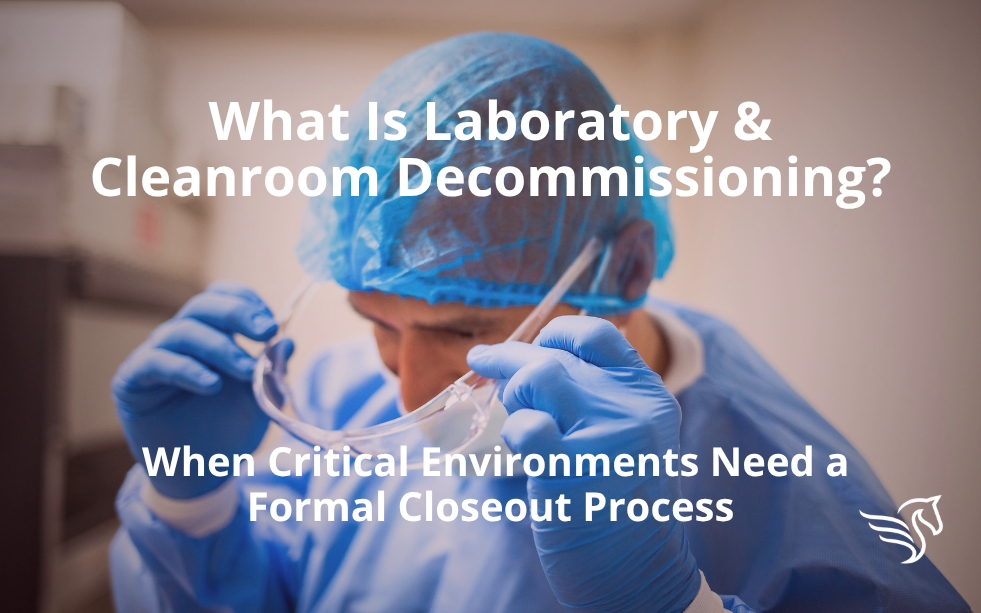
Decommissioning is the controlled process of taking a laboratory, cleanroom, or other specialized space out of service and leaving the facility, equipment, utilities, materials, and documentation in a defined condition for whatever comes next.
That next step might be a new tenant, renovation, relocation, equipment replacement, demolition, reuse, or another scientific or manufacturing program.
What Does Laboratory and Cleanroom Decommissioning Mean?
Decommissioning is more detailed than just cleaning. It is also different from simply shutting down operations.
A laboratory may stop performing research, for example, but chemicals, biological materials, contaminated equipment, samples, exhaust systems, and other hazards can remain after the research itself has ended.
Similarly, a cleanroom can stop production while contamination, process residues, equipment, filters, utilities, or specialized systems remain in place.
A complete decommissioning project can involve activities such as:
- reviewing how the space was historically used
- identifying potential contamination and hazards
- inventorying materials and equipment
- removing or transferring chemicals, biological materials, samples, and waste
- decontaminating surfaces and equipment
- coordinating equipment and utility shutdown
- supporting equipment removal or relocation
- performing appropriate final verification
- documenting the condition of the facility at turnover
Decommissioning is a comprehensive process that extends from initial planning and hazard assessment through final disposition, verification, and documentation. It is distinct from decontamination, demolition, or cleanroom classification alone.
Decommissioning vs. Decontamination
These terms are related, but they are not interchangeable.
Decontamination focuses on removing, destroying, neutralizing, or reducing contamination to a defined endpoint.
Decommissioning covers the larger transition of the facility. It may include decontamination, but it can also include inventory management, equipment disposition, utility isolation, waste handling, verification, documentation, and final acceptance.
A space can therefore be decontaminated without the entire decommissioning process necessarily being complete.
Why Are Laboratories and Cleanrooms Decommissioned?
There is no single event that causes a facility to enter decommissioning. For life sciences companies, research organizations, pharmaceutical manufacturers, universities, and advanced manufacturing facilities, decommissioning often happens during periods of significant change.
Lease Expiration or Facility Closure
A biotech company may reach the end of a lease and need to return laboratory space to the landlord in an agreed condition. The challenge is not simply moving desks and equipment.
The facility may have contained chemicals, biological materials, cold storage, laboratory equipment, controlled environments, or specialized building systems. Those conditions need to be addressed before responsibility for the space changes hands.
Laboratory Relocation
Growing organizations frequently move research operations from one facility to another. That can require the controlled transfer of laboratory equipment, samples, chemicals, biological materials, and research assets while also preparing the original facility for turnover.
Mergers, Acquisitions, or Consolidation
A merger or corporate restructuring may leave an organization with duplicate laboratories, manufacturing suites, or research facilities.
One facility may need to close while equipment and programs are consolidated elsewhere.
Cleanroom Renovation or Repurposing
A cleanroom may remain within the same organization but require decommissioning before renovation or a change in use.
Existing contamination, filtration systems, process equipment, utilities, and adjacent operating areas may all affect how work is planned.
Equipment Replacement
Sometimes an entire laboratory does not need to close. A major piece of equipment or a process tool may need to be taken out of service, decontaminated, disconnected, removed, relocated, or replaced.
That can create its own decommissioning project within an otherwise active facility.
Product or Research Program Changes
Pharmaceutical manufacturing suites, biotechnology laboratories, and research facilities may be repurposed after a product, clinical program, grant, or research initiative ends.
The space may then need to be prepared for a completely different process or occupant.
Other circumstances that may require decommissioning include principal investigator departures, contamination events, equipment changes, and changes in regulated activities. Regardless of the reason, the facility’s history and intended future use help determine the appropriate decommissioning requirements.
What Types of Facilities May Require Decommissioning?
Although laboratory decommissioning is a common term, the concept extends across many types of critical and controlled environments.
Biotechnology and Life Sciences Laboratories
Biotech facilities can contain chemicals, biological materials, specimens, freezers, biological safety cabinets, analytical equipment, and other assets requiring controlled disposition.
Funding changes, relocation, M&A activity, expansion, contraction, and lease expiration can all trigger decommissioning.
Pharmaceutical and GMP Facilities
Pharmaceutical environments can introduce additional concerns involving contamination control, equipment retirement, documentation, quality systems, and the preparation of manufacturing spaces for their next use.
Cleanrooms
Cleanroom decommissioning may require specialized cleaning and decontamination of surfaces, equipment, HEPA systems, and other components. The final requirements depend heavily on what will happen to the space afterward.
A cleanroom that will continue operating as a classified environment may require a very different final condition from one being prepared for demolition.
University and Research Laboratories
Universities may need to decommission laboratories when a principal investigator retires or leaves, a grant ends, a department relocates, or a laboratory is renovated.
Semiconductor and Advanced Manufacturing Cleanrooms
These semiconductor and advanced manufacturing cleanroom environments can present a different set of challenges involving process chemicals, specialty gases, vacuum systems, process residues, equipment, and sensitive controlled environments.
Why Can’t a Facility Simply Be Cleaned and Emptied?
One of the biggest misconceptions about decommissioning is that once the visible materials and equipment are gone, the space is finished.
In critical environments, contamination is not always visible. Residues can remain inside equipment, exhaust systems, ductwork, filters, pumps, drains, freezers, process systems, or other components. During normal operations, those materials may have been safely contained.
During decommissioning, however, workers may open systems, disconnect utilities, move equipment, remove filters, or disturb components that were rarely touched during routine operations.
That means the sequence of work becomes extremely important.
Activities such as opening ductwork, disconnecting gas lines, moving laboratory freezers, cutting into process equipment, or removing HEPA filters can disturb containment systems that were designed to remain intact during routine operations. Identifying potential hazards before these activities begin is an important part of protecting workers and preventing the unintended spread of contamination.
The End Goal Matters
One of the first questions in a decommissioning project should be: What condition does this space need to be in when the project is finished?
A laboratory being returned to a landlord may have different requirements than a cleanroom being renovated. A space being demolished may have a different endpoint than one being prepared for another pharmaceutical process.
Possible outcomes include:
- lease surrender
- laboratory reuse
- cleanroom reuse
- renovation
- relocation
- demolition
- equipment resale or relocation
- transfer to another tenant
- regulatory release where applicable
Simply defining the desired outcome as an ’empty’ or ‘clean’ facility is often insufficient. The project team should establish clear, documented expectations for the final condition of the space before fieldwork begins. These expectations help determine the necessary cleaning, decontamination, verification, and turnover requirements.
Does Decommissioning Mean a Cleanroom Has Been “Certified”?
Not always. This distinction is especially important for cleanrooms.
ISO 14644 standards can be used to evaluate specific aspects of controlled-environment performance, including airborne particle concentration and certain cleanliness conditions.
But an ISO particle classification does not automatically demonstrate the absence of chemical, biological, or radiological contamination.
Those are different questions and may require different verification methods.
The appropriate verification should match both the hazards that were present and the intended future use of the facility.
When Should Decommissioning Planning Begin?
Ideally, decommissioning planning begins before equipment is disconnected and before materials start leaving the facility.
Historical records, chemical inventories, equipment information, process history, contamination concerns, permits, waste requirements, and the future use of the space can all affect how the project should proceed.
An important principle in laboratory and cleanroom decommissioning is to characterize potential hazards before disturbing equipment, materials, or facility systems. Understanding what may be present before systems are opened or equipment is moved can help reduce unexpected hazards, schedule delays, and costly changes later in the project.
Laboratory and Cleanroom Decommissioning Is a Facility Transition, Not Just a Cleaning Project
A successful decommissioning project should leave more behind than an empty room.
It should establish what hazards were present, what was removed or addressed, what verification was completed, and what condition the space was in when responsibility changed hands.
For laboratories and cleanrooms, specialized critical cleaning and decontamination can be an important part of that process.
Pegasus works in critical environments where contamination control, specialized cleaning, and documented processes matter. For organizations planning a laboratory closure, cleanroom renovation, facility relocation, or controlled-space transition, involving experienced critical-environment professionals early can help create a clearer path from shutdown through final turnover.
Planning a Laboratory or Cleanroom Transition?
Pegasus can support the critical cleaning and decontamination portion of laboratory and cleanroom decommissioning projects, from initial planning through final turnover.
Contact Pegasus to discuss your laboratory or cleanroom decommissioning requirements.
Frequently Asked Questions About Laboratory and Cleanroom Decommissioning
What is laboratory decommissioning?
Laboratory decommissioning is the controlled process of taking a laboratory out of service and preparing the space, equipment, utilities, materials, and documentation for a defined next use. That could include relocation, renovation, reuse, demolition, lease surrender, or transfer to another occupant.
What is cleanroom decommissioning?
Cleanroom decommissioning involves taking a controlled environment out of its current use while addressing contamination, equipment, filtration systems, utilities, surfaces, and other components that may need to be cleaned, decontaminated, removed, or verified before the space is reused, renovated, or demolished.
If the cleanroom will continue operating as a classified environment, the final verification requirements may be very different from those for a cleanroom being permanently removed from service.
When does a laboratory or cleanroom need to be decommissioned?
Common triggers include a lease expiration, facility relocation, merger or consolidation, research program closure, cleanroom renovation, equipment replacement, product discontinuation, contamination event, or change in regulated activities.
Is decommissioning the same as cleaning or decontamination?
No. Decontamination is one part of the larger decommissioning process.
Decontamination focuses on removing, destroying, neutralizing, or reducing contamination to an established endpoint. Decommissioning can also include planning, inventory management, equipment disposition, material removal, utility isolation, waste management, verification, documentation, and final acceptance.
How long does laboratory or cleanroom decommissioning take?
There is no universal timeline. The duration depends on factors such as facility size, contamination history, equipment, regulated materials, waste requirements, testing, regulatory involvement, and the intended final condition of the space.
Relatively straightforward laboratory decommissioning projects may take several weeks, while larger cleanroom, semiconductor, radiological, or campus-scale projects can take several months or longer. These are general planning estimates rather than regulatory deadlines. Actual timelines depend on the complexity of the facility, potential hazards, equipment disposition, verification requirements, and the condition required for final turnover.
Does ISO cleanroom certification mean a space has been fully decommissioned?
No. ISO 14644 cleanroom classification addresses specific controlled-environment cleanliness conditions, such as airborne particle concentration.
A particle-classification result does not by itself establish that chemical, biological, or radiological contamination has been cleared. Verification should be selected according to the hazards that were present and the intended future use of the facility.
What should happen before decommissioning work begins?
The project team should first define the intended end condition of the space and review available information about facility history, materials, equipment, utilities, permits, contamination concerns, and previous incidents.
A useful principle is characterize first, disturb second. Equipment, ductwork, filters, and other systems should not be opened or removed until the potential hazards are sufficiently understood.
What documentation may be provided at the end of a decommissioning project?
The closeout package depends on the project, but it may include decontamination records, analytical or verification results, equipment clearance records, asset disposition information, waste manifests, photographs, regulatory correspondence, and owner or landlord acceptance.
There is no single universal “decommissioning certificate” that replaces all of these hazard-specific records.