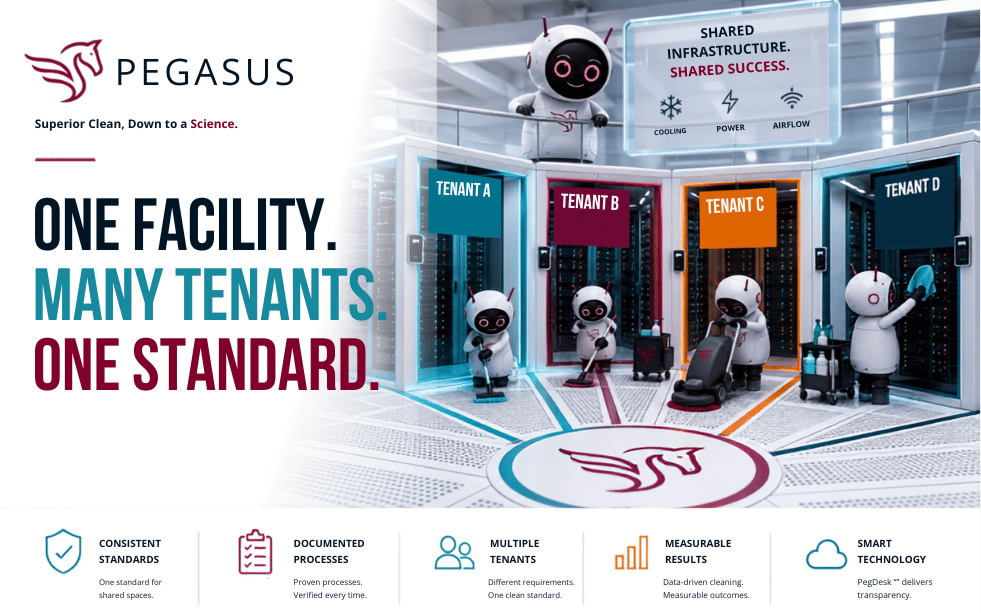
A single-tenant data center answers to one operator. A colocation data center facility answers to all of them at once.
Every cage, suite, or rack space in a multi-tenant data center facility may belong to a different customer, each with its own compliance requirements, its own access rules, and its own expectations for what “clean” means.
The facility maintenance operator still owns the common infrastructure (the raised floor, the cooling plant, the shared aisles) but cleanliness inside a tenant’s leased space is rarely as simple as sending in a crew and starting the vacuum.
That layered structure is what makes colocation cleaning a genuinely different problem than cleaning a facility one company runs top to bottom. Getting it wrong doesn’t just create a contamination issue. It can put a provider’s Service Level Agreement, its audit standing, and its tenant relationships at risk all at the same time.
Why Colocation Cleaning Isn’t Single-Tenant Cleaning at Smaller Scale
In a single-tenant facility, one team sets the cleaning schedule, the access rules, and the documentation standard, and that standard applies throughout. In a colocation environment, the operator has to run that same discipline across dozens of tenants who never agreed to the same policy in the first place.
A few things change as a result:
Access is compartmentalized. Cleaning staff working inside a tenant’s data center cage or suite typically need an escort, a scheduled access window, or prior tenant sign-off, the same physical space that a facility team could walk into freely in a single-tenant building. Whereas common areas (raised floor aisles, the building’s mechanical rooms, entry vestibules) don’t carry that restriction, which means a single cleaning visit may involve two entirely different access protocols depending on where the crew is standing.
Standards aren’t uniform. One tenant may require ISO Class 8 particle counts as a condition of their own SOC 2 report. Another tenant may have no documented cleanliness requirement at all beyond “keep it reasonably clean.” The colocation operator ends up needing to meet the strictest tenant requirement in shared spaces while still respecting each tenant’s individual expectations inside their own footprint.
Documentation has to satisfy multiple audiences. A single-tenant operator produces one cleaning record for one customer’s documentation and audit needs. A colocation provider may need to produce that same record, inspection logs, particle counts, corrective action history, in a form that can be handed to several different tenants’ auditors, each running a different compliance framework, without any one tenant seeing another tenant’s data.
None of this is a reason to treat colocation cleaning as harder. It’s a reason to treat it as a different design problem, with access, standards, and documentation built around the multi-tenant structure from the start rather than adapted from a single-tenant checklist after the fact.
Access Control Changes How Cleaning Gets Scheduled
Cleaning crews in a colocation facility can spend as much time coordinating access as they do cleaning. A cage-level job that would take twenty minutes in an unrestricted space can take considerably longer once escort scheduling, tenant notification windows, and access logging are factored in.
That has a direct effect on how cleaning programs get built:
- Common areas, raised floor aisles, shared mechanical spaces, loading docks, can run on a standard recurring schedule, the same way a single-tenant facility would plan it.
- Tenant-controlled space, cages, suites, dedicated racks, needs a schedule that’s coordinated with each tenant individually, with access windows built around their sign-off requirements rather than the cleaning provider’s convenience.
- Escort and badge logs become part of the cleaning documentation itself, not a separate security function, since they’re often the only record that proves who was inside a tenant’s space and when.
Cleaning service providers that treat access coordination as a scheduling afterthought tend to see cleaning inside tenant spaces fall behind common-area cleaning, since the common areas are simply easier to get to.
Building access coordination into the cleaning plan from the outset keeps tenant-space cleaning from becoming the thing that quietly gets skipped.
Why Shared Air Requires Shared Standards
Contamination doesn’t respect lease boundaries. Dust generated in a common area moves with the building’s airflow into every cage that shares that air, regardless of which tenant’s cleanliness clause covers which square footage.
That’s why the practical standard in most colocation facilities ends up being the strictest requirement among the tenants sharing that airflow, applied to the shared infrastructure, the raised floor plenum, return air pathways, overhead cable trays, rather than a different standard per cage.
Enterprise tenants placing workloads in colocation facilities increasingly request documentation of environmental cleanliness as part of vendor due diligence, and many reference ISO 14644-1 Class 8 as the benchmark equipment manufacturers expect, a standard also referenced by ASHRAE Technical Committee 9.9.
A provider that can already demonstrate that standard across shared infrastructure is answering that due diligence question before a prospective tenant has to ask it.
Pegasus has covered the ISO 14644-1 classification question in more depth in its guide to data center cleanliness standards, which is worth reading alongside this piece for the specifics of what Class 8 actually requires, and for why equipment manufacturers increasingly tie warranty coverage to it.
Keeping Cleaning Consistent Across Shifts, Buildings, and Tenants
A colocation provider running multiple facilities, or even multiple shifts inside one facility, faces a version of a problem every large cleaning program eventually runs into: execution drifts.
With a traditional cleaning company, one technician interprets a task differently than another.
A supervisor without a structured verification process misses a deviation. None of it looks dramatic in the moment, the facility still looks clean, and complaints stay low, but the variability compounds, and in a multi-tenant environment it compounds across every tenant relying on the same shared standard.
That risk is worth taking seriously specifically because colocation facilities have more surface area for it than a single-tenant building does: more shifts, more buildings, and more tenants each capable of noticing when the standard applied to their space doesn’t match what a neighboring tenant is getting.
Pegasus has written more broadly about the operational risk hidden in inconsistent cleaning programs, and the pattern it describes, standardized workflows drifting apart across shifts and locations without structured verification to catch it, is exactly the failure mode a multi-tenant facility is most exposed to.
Documentation Has to Work for Tenants Who Never Talk to Each Other
Single-tenant documentation is straightforward: one operator, one record, one auditor. Colocation documentation has to hold up when several tenants, who have no visibility into each other’s operations, each request the same underlying evidence for different reasons.
That typically means:
- Facility-wide records for shared infrastructure (raised floor, mechanical rooms, common aisles) that any tenant’s auditor can review without exposing another tenant’s information
- Tenant-specific records for work performed inside a leased cage or suite, retained separately and released only to that tenant
- A consistent retention period across both, since SOC 2 Type 2 reports typically review a 12-month period and many enterprise tenants request two to three years of retained records to cover overlapping audit cycles
- Named accountability on every record, which technician performed the work and which supervisor verified it, since anonymous logs carry far less weight with an auditor than records that show who did the work and who checked it
Pegasus has written more on how these retention and evidentiary requirements play out for data center audit documentation, including how SOC 2’s Trust Services Criteria treat physical and environmental controls as part of the audit scope, and what auditors specifically look for when comparing written procedure against actual records.
One Cleaning Schedule Doesn’t Fit Every Tenant
Cleaning frequency in a colocation facility isn’t just a question of how often, it’s a question of whose workload is driving the answer. A tenant running a data center with high-density AI or GPU compute generates a different contamination and thermal profile than a tenant running standard enterprise storage, and a single cleaning cadence applied uniformly across both tends to under-serve one and over-serve the other.
Pegasus has laid out a broader framework for building the right data center cleaning cadence based on workload density and contamination profile, the same logic a colocation operator needs to apply per tenant, rather than defaulting to one facility-wide schedule regardless of what’s actually running in each cage.
When a Contamination Incident Affects Multiple Tenants at Once
A construction breach, a fire suppression discharge, or a flood in a colocation facility rarely stays contained to one tenant’s footprint, since the same shared airflow and infrastructure that carries routine contamination also carries an incident’s contamination.
That means disaster recovery cleaning in a multi-tenant facility has to account for several tenants’ equipment and SLAs simultaneously, not just one operator’s return-to-service timeline.
In a colocation setting, each of the steps needed to clean after a disaster typically needs to be documented per affected tenant, even when the underlying cause and the cleaning crew are the same across the whole facility.
Building a Colocation Cleaning Program Instead of Patching One Together
A colocation-specific cleaning program generally needs to define, in writing, before any cleaning begins:
- Which spaces are common infrastructure and which are tenant-controlled
- The access and escort protocol for each tenant space, and who owns updating it as tenants change
- The cleanliness standard applied to shared infrastructure, set at the strictest tenant requirement rather than an average
- A documentation structure that separates facility-wide records from tenant-specific ones, with named accountability on every entry
- A cadence for common-area cleaning versus tenant-space cleaning, adjusted for each tenant’s workload density rather than applied uniformly
- A process for onboarding a new tenant’s cleaning and access requirements without disrupting existing tenants’ schedules
- An incident-response plan that accounts for multiple tenants being affected by a single contamination event
Pegasus standardizes this kind of cross-shift, cross-facility consistency through its OS1(™) Cleaning Operating System, with inspection and verification handled through its PegAssure quality assurance platform, the same structure that supports the kind of facility-wide and tenant-specific documentation colocation providers are increasingly asked to produce.
Why This Matters More as Colocation Density Increases
Colocation and hyperscale facilities are absorbing a growing share of enterprise workloads that used to run in company-owned data centers, and the tenants placing those workloads are asking harder questions about the physical environment they’re paying for.
A data center cleaning service provider that can show a structured, tenant-aware cleaning and documentation program, rather than a generic facility-wide cleaning schedule, has an easier time answering that due diligence, and an easier time onboarding new tenants without renegotiating cleaning terms from scratch each time.
Working With Pegasus
Colocation and multi-tenant environments need a cleaning program built around access control, tenant-specific documentation, and a shared-infrastructure standard set high enough to satisfy every tenant drawing from the same air, not a single-tenant cleaning plan applied across a multi-tenant facility.
Pegasus provides specialized data center cleaning services for enterprise data centers, colocation facilities, hyperscale environments, and telecommunications sites, with documentation and access coordination built for tenants who each answer to their own auditors and their own compliance requirements.
Explore the full range of Pegasus critical environment cleaning services to see how colocation cleaning programs fit alongside disaster recovery, audit documentation, and ongoing maintenance support.
Frequently Asked Questions – Colocation Data Center Cleaning
Who is responsible for cleaning inside a tenant’s cage: the tenant or the colocation provider?
This varies by contract, but many colocation agreements assign common-area cleaning to the provider while leaving cage-level cleaning to the tenant, the provider, or a shared arrangement. Whatever the split, it should be defined explicitly in the lease or service agreement rather than assumed.
Does every tenant need to meet the same cleanliness standard?
Not necessarily inside their own leased space, but shared infrastructure (raised floor, return air pathways, common aisles) typically needs to meet the strictest standard among the tenants sharing that airflow, since contamination in shared air affects everyone drawing from it.
Can one tenant see another tenant’s cleaning records?
No. Facility-wide records covering shared infrastructure can generally be shared with any tenant’s auditor, but tenant-specific cleaning records should be segmented and released only to that tenant.
How does access control affect cleaning costs in a colocation facility?
Escort requirements, scheduled access windows, and tenant notification add coordination time that a single-tenant facility doesn’t need to budget for, which is why colocation cleaning programs are usually priced and scheduled differently than single-tenant contracts.
What happens when a new tenant moves in with stricter cleanliness requirements than existing tenants?
The shared infrastructure standard generally needs to be raised to meet the new tenant’s requirement, since that tenant is drawing from the same airflow and infrastructure as everyone else in the facility.
Is ISO 14644-1 Class 8 required for colocation facilities?
It isn’t a legal requirement, but it has become a common reference point that equipment manufacturers and enterprise tenants use to evaluate whether a colocation environment meets expected cleanliness standards.
How should cleaning frequency differ between a high-density tenant and a standard enterprise tenant in the same facility?
A tenant running high-density AI or GPU compute generally needs a more frequent, more targeted cleaning cadence than a standard enterprise storage tenant, since higher power density leaves less margin for particulate buildup to affect cooling performance.
If a contamination incident affects several tenants at once, does each tenant get a separate recovery record?
Typically, yes. Even when one crew and one root cause are behind the incident, each affected tenant generally needs documentation specific to their own space and equipment for their own audit and insurance purposes.