
Most data center operators know their facility should be clean. Far fewer can name the international standard that defines what clean actually means.
That standard is ISO 14644-1:2015, the global benchmark for classifying air cleanliness by particle concentration in controlled environments. It was originally developed for cleanrooms in pharmaceutical, semiconductor, and aerospace manufacturing. Today, it is also the reference framework cited by ASHRAE, equipment manufacturers, and increasingly by enterprise customers evaluating colocation and hyperscale providers.
As AI workloads push compute density higher and equipment manufacturers tighten environmental requirements, understanding ISO 14644-1 is no longer optional for facility leaders. It is becoming part of how performance, reliability, and contractual cleanliness are defined.
This guide explains what ISO 14644-1 is, how it applies to data centers, why ISO Class 8 has become the accepted reference point, and what operators should look for in a cleaning program designed to support it.
What Is ISO 14644-1?
ISO 14644-1 is the international standard that classifies the cleanliness of controlled environments based on the maximum allowable concentration of airborne particles per cubic meter of air. According to the International Organization for Standardization, the current version is ISO 14644-1:2015, which was last reviewed and confirmed in 2021.
The standard defines nine classes of cleanliness, numbered ISO Class 1 through ISO Class 9. ISO Class 1 represents the cleanest possible environment with the fewest allowable particles. ISO Class 9 represents the least restrictive controlled environment.
Particle measurements are based on size, with classification covering particles from 0.1 microns to 5 microns. To put that in perspective, a human hair is roughly 70 to 100 microns thick. The particles that affect data center equipment are far smaller than anything visible to the naked eye.
ISO 14644-1 replaced the older U.S. Federal Standard 209E, which used different units and classifications. Today, ISO 14644-1 is the globally recognized framework, which makes it especially relevant for data center operators serving multinational customers or working with international equipment manufacturers.
Why ISO 14644-1 Applies to Data Centers
Data centers were not originally the focus of ISO 14644-1. The standard was created for manufacturing cleanrooms where airborne particles can directly compromise products.
Over time, the IT industry began referencing ISO 14644-1 because data centers share something important with cleanrooms. They are controlled environments where airborne contamination directly impacts performance, reliability, and equipment life.
In a data center, particulate matter can:
- Restrict airflow through server intakes and cooling pathways
- Insulate components and contribute to thermal stress
- Settle on circuit boards where it can absorb moisture and create conductivity risks
- Accumulate on filters and cooling coils, reducing system efficiency
- Increase wear on fans and moving components
The connection between cleanrooms and data centers was formalized by ASHRAE Technical Committee 9.9, which sets thermal and environmental guidelines for mission critical facilities. In its 2011 white paper, Gaseous and Particulate Contamination Guidelines for Data Centers, ASHRAE specifically references ISO 14644-1 as the cleanliness standard for data center environments. This connection between an established cleanroom standard and the realities of modern data center operation is why ISO 14644-1 has become the default reference point.
Why ISO Class 8 Is the Reference Point for Data Centers
ASHRAE TC 9.9 recommends that data centers maintain a cleanliness level consistent with ISO 14644-1 Class 8. According to the ASHRAE white paper, data centers must be kept clean to Class 8 of ISO 14644-1. This recommendation has been widely adopted across the industry and is referenced by major equipment manufacturers and facility design guides.
ISO Class 8 was selected because it represents a practical balance. It is strict enough to protect sensitive electronics from particulate related failures, but achievable through standard data center filtration, airflow design, and structured cleaning programs.
ASHRAE specifies that ISO Class 8 cleanliness can typically be achieved through proper filtration. According to Data Center Dynamics, room air should be continuously filtered with MERV 8 filters, and air entering the data center should be filtered with MERV 11 or MERV 13 filters. Filtration alone, however, is rarely enough.
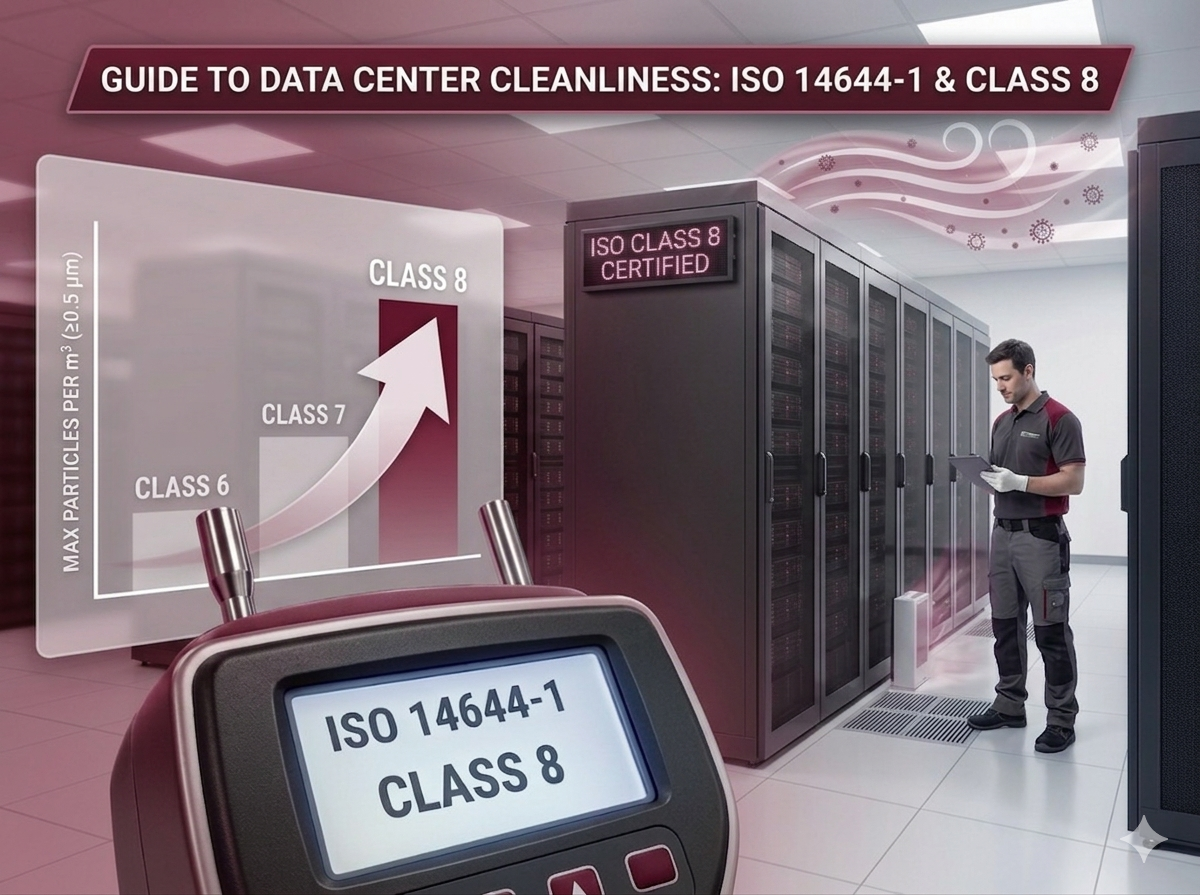
The table below summarizes the maximum allowable particle counts for ISO Class 8 compared to surrounding classes, measured in particles per cubic meter of air.
| ISO Class | Max ≥0.5 μm / m³ | Max ≥1.0 μm / m³ | Typical Application |
| Class 6 | 35,200 | 8,320 | Pharma manufacturing |
| Class 7 | 352,000 | 83,200 | Aseptic packaging |
| Class 8 | 3,520,000 | 832,000 | Data centers, server rooms |
| Class 9 | Not specified | Not specified | General controlled spaces |
Source: ISO 14644-1:2015. Maximum allowable concentrations per cubic meter of air. Particles ≥5.0 μm are addressed separately under the M descriptor in the 2015 standard.
In simple terms, an ISO Class 8 environment limits airborne particles to a level that supports reliable operation of modern IT equipment when paired with appropriate filtration, environmental control, and structured cleaning.
Why ISO 14644-1 Compliance Is Becoming a Business Requirement
Historically, ISO 14644-1 was a reference framework. Today, it is increasingly tied to commercial and contractual outcomes.
Several pressures are driving this shift:
Equipment Manufacturer Requirements
Major OEMs expect their equipment to operate in environments meeting ISO 14644-1 Class 8 cleanliness. When environmental conditions fall outside those parameters, manufacturers may dispute warranty claims for dust related failures. For high value GPU clusters and AI infrastructure, this exposure is significant.
Customer and Tenant Expectations
Colocation and hyperscale customers increasingly request documentation of environmental cleanliness as part of due diligence. Enterprise customers placing critical workloads in third party facilities want assurance that the physical environment supports their reliability requirements.
AI Infrastructure and Higher Compute Density
AI training and inference environments operate at thermal margins that leave little room for variability. As power densities rise, even small amounts of particulate accumulation can have outsized impacts on cooling efficiency and equipment reliability.
Audit and Compliance Pressure
Operators serving regulated industries such as financial services, healthcare, and government often face audit requirements that touch on environmental controls. ISO 14644-1 provides a measurable, defensible reference point for those audits.
What ISO 14644-1 Does Not Cover
It is important to understand what the standard does and does not address.
ISO 14644-1 classifies airborne particle concentration. It does not specify:
- Cleaning frequency or scope of work
- Specific cleaning methods, tools, or chemicals
- Surface cleanliness on equipment, raised floors, or cable trays
- Gaseous contamination, which is addressed separately under ANSI/ISA 71.04. ASHRAE TC 9.9 references this standard alongside ISO 14644-1 for data center environmental control
- Operational practices for entry control, packaging, or material staging
This is why ISO 14644-1 should be treated as a target outcome rather than a complete program. Achieving and maintaining ISO Class 8 conditions in a working data center requires a structured cleaning program that addresses surfaces, subfloors, overhead infrastructure, and operational protocols, all of which influence the airborne particle environment.
How Cleaning Programs Support ISO 14644-1 Compliance
Filtration alone cannot maintain ISO Class 8 conditions in an active data center. Foot traffic, packaging, maintenance work, and routine activity all introduce particles that filters cannot capture before they settle on surfaces or accumulate in airflow pathways.
ASHRAE explicitly addresses this in its Particulate and Gaseous Contamination in Datacom Environments publication, noting that sources of dust inside data centers should be reduced. A structured cleaning program supports ISO 14644-1 compliance by addressing those sources directly.
Raised Floor and Subfloor Cleaning
Subfloor environments collect cable debris, concrete dust, and particulate that gets redistributed when air pressure changes. Cleaning these areas reduces the source material that becomes airborne.
Equipment Surface Cleaning
Server racks, network equipment, and supporting infrastructure accumulate dust on surfaces and vents. ESD safe cleaning methods remove this contamination without introducing static or moisture risk.
Overhead and Cable Tray Cleaning
Overhead structures and cable trays often go unaddressed in standard cleaning programs. Particulate on these surfaces can fall into equipment racks and disrupt airflow patterns.
Entry and Transition Zones
Entry mats, vestibule cleaning, and packaging removal protocols reduce the volume of contamination introduced through foot traffic and material handling.
Documentation and Verification
ISO 14644-1 references particle measurement and verification using calibrated light scattering airborne particle counters. A cleaning program that includes documented workflows, inspection records, and verification reporting provides the audit trail operators need to demonstrate environmental control.
What Operators Should Look For in a Cleaning Partner
Not every cleaning provider is equipped to support ISO 14644-1 environments. Operators evaluating partners should look for several specific capabilities.
- Experience working in mission critical environments where uptime is non negotiable
- Standardized workflows that reduce variability between technicians, shifts, and buildings
- ESD safe tools, HEPA filtered equipment, and approved methods for sensitive environments
- Documented procedures aligned with airflow protection and contamination control
- Quality assurance and inspection processes that produce measurable verification
- Reporting systems that create an audit trail
In ISO referenced environments, consistency is the foundation of compliance. A partner that cannot demonstrate process discipline cannot reliably support ISO Class 8 outcomes.
How Pegasus Supports ISO 14644-1 Aligned Environments
Pegasus delivers structured cleaning programs designed for performance driven environments where cleanliness directly affects equipment reliability and uptime.
Through the OS1™ Cleaning Operating System, Pegasus standardizes workflows across shifts, technicians, and facilities. This reduces variability, which is the most common reason cleaning programs drift away from defined cleanliness targets.
PegAssure, the Pegasus quality assurance platform, provides inspection, verification, and reporting that creates a documented audit trail. For operators referencing ISO 14644-1 in customer commitments or compliance frameworks, this documentation is essential.
Pegasus data center services support enterprise data centers, colocation facilities, hyperscale environments, and AI infrastructure. Programs are designed around the realities of mission critical operation, including ESD safe practices, controlled access workflows, and cleaning protocols that protect engineered airflow.
ISO 14644-1 Is the Floor, Not the Ceiling
ISO 14644-1 Class 8 has become the reference point for data center cleanliness, but it should be understood as a baseline rather than an aspirational target.
Operators running AI infrastructure, high density compute, or facilities serving regulated customers should expect cleanliness expectations to continue tightening. The combination of higher thermal loads, more sensitive equipment, and increased customer scrutiny means the margin for variability is shrinking.
Treating ISO 14644-1 as an operational floor rather than a checkbox positions facilities to support performance today and adapt to tomorrow’s requirements.
Get Your Free Facility Blueprint
If your facility is evaluating how to align with ISO 14644-1 cleanliness expectations, document environmental controls, or strengthen your data center cleaning program, Pegasus can help.
Contact Pegasus to schedule a facility evaluation and receive a customized Facility Blueprint designed to support your operational and compliance goals.
Frequently Asked Questions About ISO 14644-1 and Data Center Cleaning
What is ISO 14644-1?
ISO 14644-1 is the international standard that classifies air cleanliness in controlled environments based on the maximum allowable concentration of airborne particles per cubic meter of air. It defines nine classes of cleanliness, with ISO Class 1 being the cleanest and ISO Class 9 the least restrictive. The current version is ISO 14644-1:2015, which was confirmed in 2021.
Which ISO 14644-1 class applies to data centers?
ISO Class 8 is the cleanliness level recommended by ASHRAE Technical Committee 9.9 for data centers. ISO Class 8 represents a practical balance between protecting sensitive electronics and being achievable through filtration, airflow design, and structured cleaning programs.
Is ISO 14644-1 a legal requirement for data centers?
ISO 14644-1 is not a legal regulation, but it is increasingly referenced in equipment warranties, customer contracts, audit frameworks, and compliance programs. While not a law, it functions as a de facto standard for environmental cleanliness in mission critical environments.
Can a data center achieve ISO Class 8 with filtration alone?
Filtration is essential, but it cannot maintain ISO Class 8 conditions on its own. ASHRAE recommends MERV 8 filtration for room air and MERV 11 to MERV 13 filtration for incoming air, but also notes that sources of dust inside data centers should be reduced. Foot traffic, packaging, maintenance work, and operational activity continually introduce particulate that requires structured cleaning to address.
How is ISO 14644-1 compliance measured in a data center?
Compliance is measured by sampling airborne particle concentrations using calibrated light scattering airborne particle counters at defined locations within the facility. ISO 14644-1:2015 specifies the methodology for sample location selection, measurement, and statistical interpretation, and references ISO 21501-4 for instrument requirements.
What is the difference between ISO 14644-1 and ASHRAE guidelines?
ISO 14644-1 defines air cleanliness classifications. ASHRAE TC 9.9 provides specific environmental guidelines for data centers, including thermal, humidity, and contamination recommendations. ASHRAE references ISO 14644-1 Class 8 as the recommended cleanliness target for data centers in its 2011 contamination guidelines white paper.
Does ISO 14644-1 cover gaseous contamination?
No. ISO 14644-1 addresses airborne particulate contamination only. Gaseous contamination is covered separately under ANSI/ISA 71.04, which classifies corrosive gas levels in controlled environments. ASHRAE references both standards for data center environmental control.
How often should a data center be cleaned to maintain ISO 14644-1 standards?
Cleaning frequency depends on facility size, equipment density, traffic levels, nearby construction activity, and customer requirements. Many facilities implement scheduled cleaning programs aligned with maintenance cycles. A facility assessment can determine the appropriate cleaning cadence based on environmental conditions and operational priorities.
What happens if a data center does not meet ISO 14644-1 Class 8?
Operating below ISO Class 8 cleanliness can increase the risk of equipment failure, reduce cooling efficiency, accelerate component wear, and create exposure with equipment manufacturers, customers, and auditors. In some cases, warranty claims for dust related failures may be challenged if environmental conditions cannot be documented.
How does Pegasus support ISO 14644-1 aligned cleaning programs?
Pegasus delivers structured cleaning programs through the OS1 Cleaning Operating System, which standardizes workflows across shifts and facilities. PegAssure provides inspection, verification, and documentation to support audit readiness. Programs are designed for mission critical environments including data centers, colocation facilities, hyperscale environments, and AI infrastructure.


