In many facilities, disinfection is treated as a routine task. Surfaces are cleaned, spaces look presentable, and operations continue. But in environments where contamination risk, compliance, and uptime matter, visual cleanliness is not a reliable indicator of safety. What cannot be seen is often what creates the greatest operational risk.
Hydrogen peroxide fogging is a specific, controlled decontamination service designed to address those gaps. It is not a general cleaning add-on or a cosmetic solution. It is used when there is a need for broad, consistent, and measurable disinfection coverage across an entire space.
For facility leaders, the challenge is not understanding that hydrogen peroxide fogging works. The challenge is understanding when it is necessary, how it fits into existing operations, and how to implement it without creating disruption.
What Hydrogen Peroxide Fogging Actually Does
Hydrogen peroxide fogging is designed to solve a fundamental limitation in traditional cleaning: inconsistent coverage. Manual cleaning relies on direct contact with surfaces, which means effectiveness depends on access, time, and human execution. Even well-managed teams can leave gaps over time, especially in complex or high-use environments.
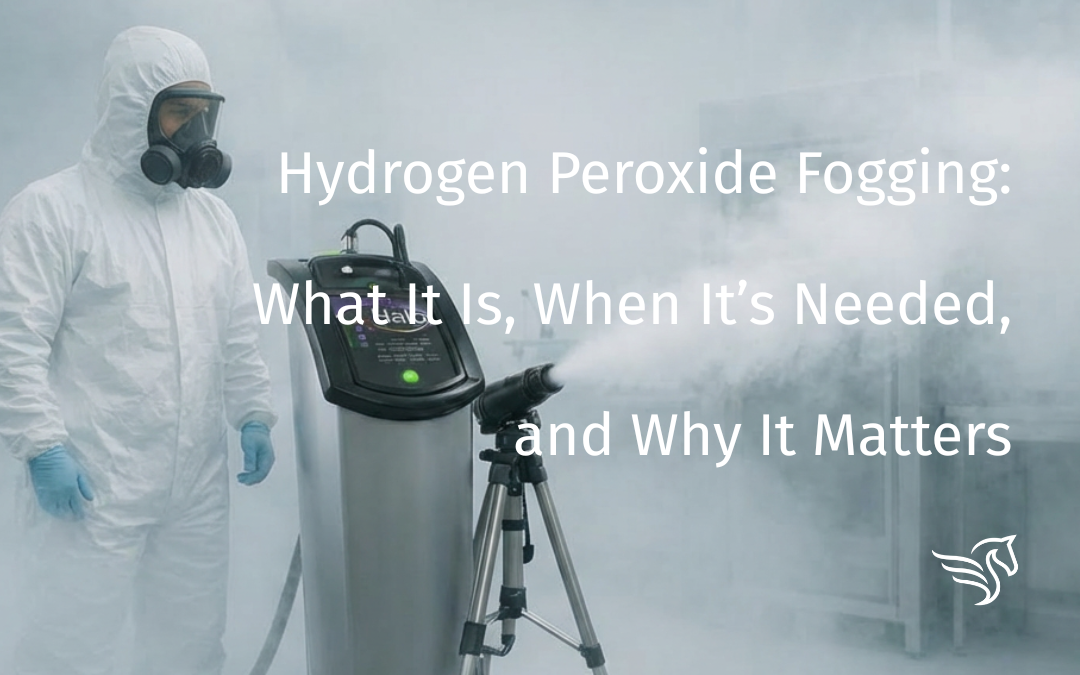
Hydrogen peroxide fogging uses specialized equipment to disperse a measured concentration of hydrogen peroxide as a fine mist throughout a controlled space. This allows the disinfectant to settle across a wide range of surfaces, including areas that are difficult or impossible to reach through manual methods.
What it reaches that manual cleaning often misses:
- Hard-to-reach crevices and seams
- Vertical and overhead surfaces
- High-touch areas with inconsistent coverage
- Areas where airborne contaminants can settle
Because hydrogen peroxide breaks down into water and oxygen, it is widely used in environments where residue must be minimized. Hydrogen peroxide fogging improves coverage across a space, but it is designed to enhance, not replace, foundational cleaning processes.
Where Hydrogen Peroxide Fogging Fits in a Cleaning Program
No single cleaning method can fully address the range of risks present in modern facilities. Effective cleaning programs are structured, layered, and designed to address both visible cleanliness and invisible contamination risks.
Hydrogen peroxide fogging fits into this structure as a targeted decontamination step. Routine cleaning removes soil and prepares surfaces, while fogging extends disinfection into areas manual methods may not consistently reach.
How it is typically used:
- As a supplement to routine cleaning protocols
- As a response to contamination or exposure events
- As a scheduled intervention in high-risk environments
Its use is deliberate rather than constant, aligned with specific operational needs rather than general upkeep.
When integrated into a defined cleaning program, hydrogen peroxide fogging strengthens overall consistency and control rather than functioning as an isolated service.
Why Facilities Use Hydrogen Peroxide Fogging
Facilities implement hydrogen peroxide fogging to address challenges that extend beyond standard cleaning performance. In many environments, the issue is not whether cleaning is happening, but whether it is happening consistently enough to reduce risk.
Manual cleaning introduces variability across technicians, shifts, and locations. Over time, these inconsistencies can create exposure, particularly in environments where contamination has operational or compliance consequences.
Common drivers for implementation:
- Inconsistent disinfection coverage across teams or facilities
- Elevated contamination risk in sensitive environments
- Post-event decontamination after illness or exposure
- The need for documented, repeatable processes for compliance
Hydrogen peroxide fogging introduces a more controlled and repeatable method of disinfection that helps reduce that variability.
Facilities adopt hydrogen peroxide fogging not for appearance, but to reduce uncertainty in environments where consistency is critical.

Industries Where Hydrogen Peroxide Fogging Delivers the Most Value
The value of hydrogen peroxide fogging increases as the consequences of contamination increase. While it can be used in a range of environments, it is most impactful in facilities where cleanliness directly affects safety, compliance, or operational performance.
Industries that benefit most include:
- Life Sciences and GMP Facilities: Supports contamination control and regulatory compliance
- Healthcare and Medical Environments: Helps reduce pathogen exposure risk
- Data Centers and High-Tech Facilities: Supports particulate control with careful application
- Laboratories and Research Facilities: Reduces cross-contamination risk
- Corporate and High-Traffic Facilities: Used after outbreaks or high-occupancy events
As the sensitivity of the environment increases, the value of controlled, consistent disinfection becomes more significant.
Operational Considerations Facility Leaders Must Plan For
Implementing hydrogen peroxide fogging is not just a technical decision. It is an operational one that affects scheduling, access, and facility workflows.
Key operational factors to consider:
- Downtime requirements: Spaces must be vacated, with dwell time and aeration before re-entry
- Material compatibility: Repeated exposure may impact finishes or sensitive equipment
- Application consistency: Effectiveness depends on proper distribution and execution
Without proper planning, fogging can disrupt operations instead of supporting them.
The success of hydrogen peroxide fogging is determined less by the product itself and more by how well the process is planned and executed.
Safety and Compliance Considerations
Because hydrogen peroxide fogging involves airborne chemical application, it introduces specific safety and compliance requirements. These are especially important in regulated environments where documentation and process control are essential.
Facilities must ensure:
- Proper concentration levels are used
- Application aligns with manufacturer and regulatory guidance
- Staff are trained in handling and exposure protocols
- Documentation is maintained for audits and verification
This documentation typically includes when fogging was performed, why it was performed, and how it was executed.
When managed correctly, hydrogen peroxide fogging supports compliance efforts. When managed poorly, it can introduce additional risk.
Common Misconceptions About Hydrogen Peroxide Fogging
As hydrogen peroxide fogging becomes more widely used, misconceptions can lead to ineffective or inefficient application.
Common misunderstandings include:
- Fogging replaces manual cleaning
- More frequent fogging leads to better results
- Fogging guarantees complete disinfection
In reality, surfaces must be cleaned before disinfection, overuse can create unnecessary disruption, and effectiveness depends on proper application and environmental conditions.
Clear understanding of what hydrogen peroxide fogging can and cannot do is essential to using it effectively.
When Hydrogen Peroxide Fogging Makes Sense
Hydrogen peroxide fogging is most valuable when there is a defined need for consistent, full-environment disinfection that cannot be achieved through manual cleaning alone.
Best-fit scenarios include:
- Environments with elevated contamination risk
- Facilities requiring consistent, repeatable disinfection processes
- Post-event or post-exposure decontamination
- Controlled environments that can support downtime and process control
It is not designed for routine use in every facility, but for targeted application where risk justifies it.
The decision to implement hydrogen peroxide fogging should be based on risk and operational requirements, not routine use.
Hydrogen peroxide fogging is not a general cleaning add-on or a one-size-fits-all solution. It is a controlled, purpose-built service designed to extend disinfection beyond what manual processes alone can achieve. When used correctly, it improves coverage, supports consistency across environments, and provides a structured way to respond to elevated contamination risk. Its value becomes most apparent in facilities where precision, compliance, and operational continuity are critical, and where variability in cleaning can introduce real exposure.
At the same time, it requires planning, trained execution, and proper documentation to be effective and safe, particularly in environments with sensitive equipment or regulatory oversight. Facilities that see the greatest benefit are those that treat hydrogen peroxide fogging as part of a broader system, integrating it into defined protocols rather than relying on it as a standalone solution.
If you are evaluating whether hydrogen peroxide fogging is the right fit for your facility, Pegasus can help assess where it adds value and how to implement it within a structured, compliant cleaning program. When aligned correctly, it becomes a reliable method for reducing risk, supporting compliance, and maintaining a higher standard of environmental control.
FAQ: Hydrogen Peroxide Fogging
What is hydrogen peroxide fogging used for?
Hydrogen peroxide fogging is used to achieve consistent, full-environment disinfection in spaces where manual cleaning alone may not provide adequate coverage. It is commonly used in controlled environments, post-contamination events, and facilities with elevated compliance requirements.
Does hydrogen peroxide fogging replace regular cleaning?
No. Hydrogen peroxide fogging is not a replacement for manual cleaning. Surfaces must first be cleaned of dirt and residue before fogging can be effective. It works as a supplemental step to extend disinfection coverage.
Is hydrogen peroxide fogging safe?
When performed correctly, hydrogen peroxide fogging is safe. The process uses controlled concentrations and requires proper handling, trained personnel, and adherence to safety protocols, including vacating the space during application and allowing for proper aeration.
How long does hydrogen peroxide fogging take?
The total time depends on the size and complexity of the space, but typically includes:
- Application time
- Dwell time for disinfection effectiveness
- Aeration time before re-entry
Planning is required to minimize disruption to operations.
What types of facilities benefit most from hydrogen peroxide fogging?
Hydrogen peroxide fogging is most beneficial in environments where contamination has a direct impact on safety, compliance, or performance, including:
- Life sciences and GMP facilities
- Healthcare environments
- Data centers and high-tech facilities
- Laboratories and research spaces
- High-traffic commercial environments
Can hydrogen peroxide fogging damage equipment or surfaces?
When improperly applied, repeated exposure can impact certain materials or sensitive equipment. This is why proper assessment, controlled application, and experienced providers are critical, especially in technical environments.
How often should hydrogen peroxide fogging be performed?
There is no universal schedule. Frequency depends on the level of risk, type of facility, and specific use case. It is typically used as a targeted intervention rather than a routine daily or weekly service.
Is hydrogen peroxide fogging required for compliance?
Hydrogen peroxide fogging is not universally mandated, but it can support compliance in specific regulated environments where contamination control and documented disinfection are required. Examples include:
- GMP pharmaceutical and biotech manufacturing (FDA cGMP)
- Compounding pharmacies (USP <797> and <800>)
- Healthcare facilities guided by CDC standards and Joint Commission requirements
- Cleanrooms and controlled environments (ISO 14644 classifications, EU GMP Annex 1)
- Laboratories handling sensitive materials (including BSL environments)
- Food processing facilities operating under FSMA and sanitation controls
In these environments, fogging can help standardize disinfection, support contamination control strategies, and provide documented processes for audits, even when it is not explicitly required as a standalone service.