
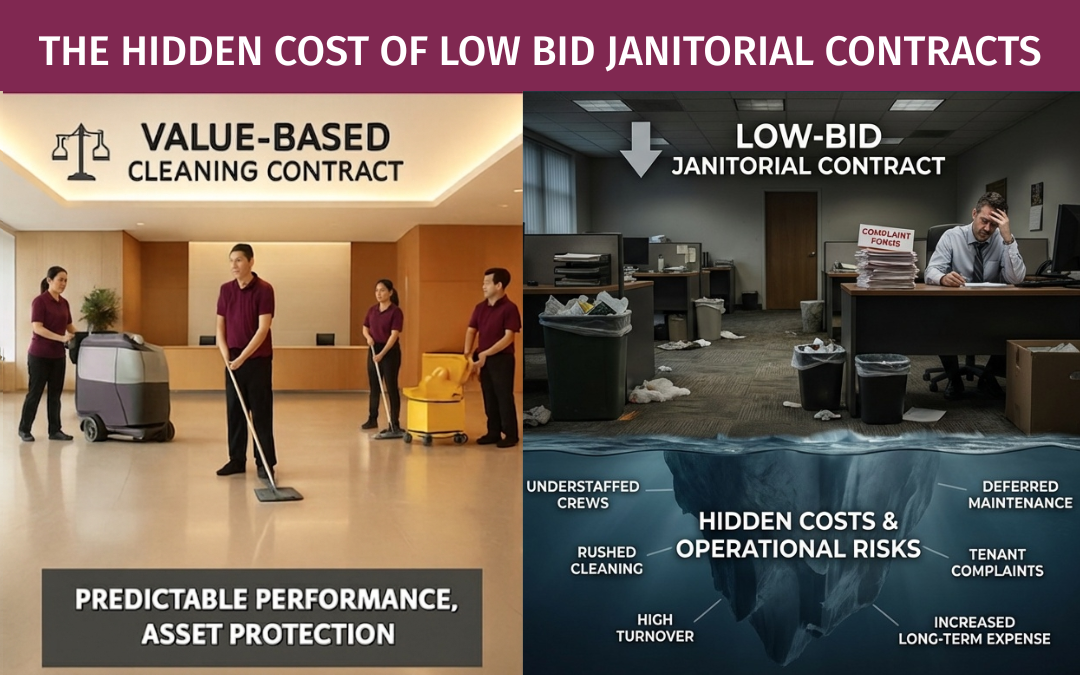
How low-cost vendors increase risk, reduce accountability, and drive up long-term operational costs
At first glance, selecting the lowest-priced janitorial contract seems like a responsible financial decision. Budgets matter. Cost control matters. On paper, the lowest bid often appears to check both boxes.
But in facility management, cost and value are not the same.
In practice, the cheapest cleaning contract frequently introduces operational issues that create more expense, more risk, and more management burden over time. What begins as a cost-saving measure often becomes a source of ongoing problems that impact the entire facility.
What Actually Happens with Low-Cost Cleaning Contracts
When a commercial janitorial provider competes primarily on price, something has to give. In most cases, in today’s facilities environment, expectations are higher than ever. Buildings are more complex. Compliance requirements are stricter. Occupants expect cleaner, safer, and more consistent environments, whether in healthcare, advanced manufacturing, or commercial office space.
At the same time, facility managers are under constant pressure to control costs.
This tension often leads to one critical decision point: selecting a janitorial provider.
On paper, the lowest bid can appear to solve the problem. It checks the budget box. It aligns with procurement expectations. It creates the perception of immediate savings.
But facility operations are not driven by line items, they are driven by outcomes.
Commercial cleaning is not just about appearance. It directly impacts asset longevity, health and safety standards, tenant satisfaction, and operational continuity. When these factors are not built into the service model, the risk does not disappear; it shifts.
And it typically shifts back to the facility manager.
That is where low-cost cleaning contracts begin to break down.
When a janitorial provider competes primarily on price, something has to give. In most cases, it is the structure and execution of the cleaning program.
Understaffed Crews
Low bids often mean reduced labor hours. Crews are spread too thin to properly service the facility, leading to missed tasks and inconsistent coverage.
Rushed and Incomplete Cleaning
When time is limited, quality suffers. High-touch areas, corners, and less-visible spaces are skipped or only partially cleaned.
High Employee Turnover
Lower wages typically result in frequent staff turnover. This creates inconsistency, a lack of familiarity with the facility, and repeated onboarding gaps.
Limited Supervision and Accountability
Without a structured management layer, there is little oversight to ensure standards are being met. Issues go unnoticed or unresolved.
Deferred Maintenance
Improper cleaning techniques and inconsistent care accelerate wear on flooring, carpets, and surfaces, leading to premature deterioration.

The Operational Impact on Facility Managers
Over time, these issues compound and shift the burden back onto the facility manager.
Instead of focusing on performance and strategic initiatives, time is redirected toward managing cleaning-related problems:
- Increased tenant or employee complaints
- More frequent deep cleaning or restoration projects
- Accelerated wear and replacement of assets
- Ongoing vendor communication and issue resolution
What initially looked like savings begins to erode operational efficiency and increase the total cost of ownership.
Cleaning Is an Operational System, Not a Commodity
Professional facility cleaning should not be treated as a simple line item. It is a system that directly impacts:
- Building longevity
- Health and safety standards
- Compliance readiness
- Tenant and employee experience
At Pegasus, this is where structured systems like OS1™ make a measurable difference. Cleaning becomes predictable, measurable, and aligned with operational goals rather than reactive and inconsistent.
What Facility Leaders Should Evaluate Instead of Price Alone
To avoid the long-term risks of low-cost contracts, facility managers should evaluate janitorial providers based on structure, accountability, and long-term performance.
Production Rates and Staffing Plans
Are labor hours aligned with the size, complexity, and usage of the facility?
Training and Supervision Structure
Is there a defined system for onboarding, ongoing training, and management oversight?
Quality Control Processes
How is performance measured, documented, and improved over time?
Insurance, Compliance, and Certifications
Does the provider meet industry requirements for safety, liability, and regulatory compliance?
Long-Term Maintenance Strategy
Is there a proactive plan to preserve flooring, carpets, and high-touch surfaces?
When these elements are clearly defined and consistently executed, cleaning becomes predictable, measurable, and aligned with operational goals. This is the difference between a facilities maintenance vendor that simply performs tasks and a partner that actively supports facility performance.
The Real Value of a Structured Cleaning Partner
A well-designed cleaning program does more than maintain appearances. It protects the facility, reduces risk, and frees up time for facility leaders to focus on higher-value responsibilities.
When cleaning is executed as a system:
- Issues are prevented rather than constantly addressed
- Asset lifespan is extended
- Operational visibility improves
- Facility teams regain time and control
This is where cleaning shifts from a reactive task to a proactive operational function. Instead of managing problems, facility leaders gain a system that supports performance, consistency, and long-term asset protection.
Price Matters. But Performance Matters More.
Cost will always be a factor in janitorial vendor selection. But when price becomes the primary decision driver, it often introduces hidden costs that outweigh the initial savings.
Facility leaders who prioritize structure, accountability, and consistency rarely need to switch providers. The right partner reduces problems instead of creating them.

FAQ: Choosing the Right Janitorial Partner
What are the risks of choosing a janitorial provider based on price alone?
Selecting a provider based only on price often results in understaffing, inconsistent service, and lack of accountability. Over time, this leads to higher operational costs, increased complaints, and faster deterioration of facility assets.
Why do low-cost cleaning contracts lead to higher long-term expenses?
Lower-cost contracts typically reduce labor hours, supervision, and training. This results in missed tasks, improper cleaning methods, and deferred maintenance, all of which increase the need for repairs, deep cleaning, and asset replacement.
How does janitorial service quality impact facility performance?
Cleaning quality directly affects employee productivity, tenant satisfaction, health and safety standards, and overall building condition. Poor cleaning introduces risk, while consistent, high-quality service supports smooth operations and compliance.
What should facility managers evaluate when comparing cleaning vendors?
Facility managers should review staffing plans, production rates, training programs, supervision structure, quality control systems, compliance certifications, and long-term maintenance strategies. These factors determine consistency and performance, not just cost.
What is a structured cleaning program?
A structured cleaning program is a systemized approach that defines scope, staffing, processes, and quality control. It ensures consistent results, measurable performance, and accountability across all areas of the facility.
How does staffing impact cleaning quality?
Proper staffing ensures that all areas receive the time and attention required for thorough cleaning. When crews are understaffed, tasks are rushed or skipped, leading to inconsistent results and long-term maintenance issues.
Why is employee turnover a concern in janitorial services?
High turnover leads to inconsistent service, lack of familiarity with the facility, and repeated training gaps. Stable teams are more efficient, more accountable, and better equipped to maintain consistent standards.
How does poor cleaning affect building assets like floors and carpets?
Improper or inconsistent cleaning accelerates wear on surfaces. Floors lose their finish faster, carpets break down, and high-touch areas degrade, resulting in increased repair and replacement costs.
What role does supervision play in janitorial service quality?
Supervision ensures that cleaning standards are met consistently. Without oversight, issues go unnoticed, quality declines, and there is no accountability for performance.
How can facility managers reduce cleaning-related issues?
Facility managers can reduce issues by partnering with providers that offer structured systems, clear communication, measurable performance metrics, and proactive maintenance plans.
Is it better to invest more upfront in janitorial services?
In most cases, yes. A properly structured cleaning program reduces long-term costs by preventing issues, extending asset life, and minimizing operational disruptions.
How does a strong janitorial partner support compliance and safety?
A qualified provider follows industry standards, uses proper cleaning protocols, and maintains documentation and processes that support audits, safety requirements, and regulatory compliance.


