Recovery typically follows six steps: site safety assessment, contaminant removal, subfloor and equipment surface cleaning, ESD-safe floor restoration, environmental sampling, and final sign-off before re-energizing equipment. Hyperscale and AI facilities recover fastest when they pre-contract a specialized data center cleaning partner before a disaster occurs, not after.
What is data center disaster recovery cleaning?
Data center disaster recovery cleaning is the structured process of decontaminating a critical IT environment after a fire, flood, smoke event, severe storm, construction breach, or other contamination incident, so servers, switches, raised floors, and supporting infrastructure can safely return to operation.
It is not the same as routine janitorial work or even standard data center cleaning. Recovery cleaning addresses three specific risks at once:
- Particulate contamination that can short-circuit electronics or trigger smoke detectors
- Conductive or corrosive residue (soot, salt, mineral deposits) that attacks circuit boards over time
- Moisture and biological growth (mold, mildew) that compromise air quality and hardware reliability
Each of these risks compounds the longer it goes untreated, which is why the goal of recovery cleaning isn’t just visible cleanliness. It’s returning the facility to a contamination level that meets ISO 14644-1 cleanliness standards for data centers and allows uptime to resume without latent failures down the road.
Operators who treat this as a “wipe it down and turn it back on” exercise often end up with hardware failures weeks or months later, traced back to residue that was never properly addressed.1 cleanroom standards, ESD protocols (ANSI/ESD S20.20), and OSHA hazmat training for fire and flood remediation.
When do data centers need disaster recovery cleaning?
Disaster recovery cleaning is triggered by a specific event rather than a calendar schedule.
The most common triggers we see in 2026:
| Event | Primary contamination | Typical recovery focus |
| Flood or water intrusion | Moisture, mineral residue, mold risk | Subfloor drying, encapsulation, mold remediation |
| Fire or smoke event | Soot, corrosive byproducts | HEPA vacuuming, surface decontamination, equipment cleaning |
| Hurricane or tornado | Wind-driven debris, water, dust | Full-facility particulate removal, raised floor cleanup |
| HVAC failure | Dust accumulation, condensation | Environmental sampling, anti-static floor care |
| Construction or renovation breach | Drywall dust, concrete particulate | Subfloor and equipment surface cleaning |
| Wildfire smoke infiltration | Fine particulate, ash | HEPA filtration cycles, surface decontamination |
Wildfire smoke has become a growing concern across the western U.S., and it deserves a closer look. Even facilities far from active burns can pull fine ash through outside air intakes, where it settles on cabinets, cable trays, and inside server chassis.
Many operators don’t realize they’ve been affected until cooling efficiency drops or particle counts climb during routine monitoring, by which point the contamination is already widespread.
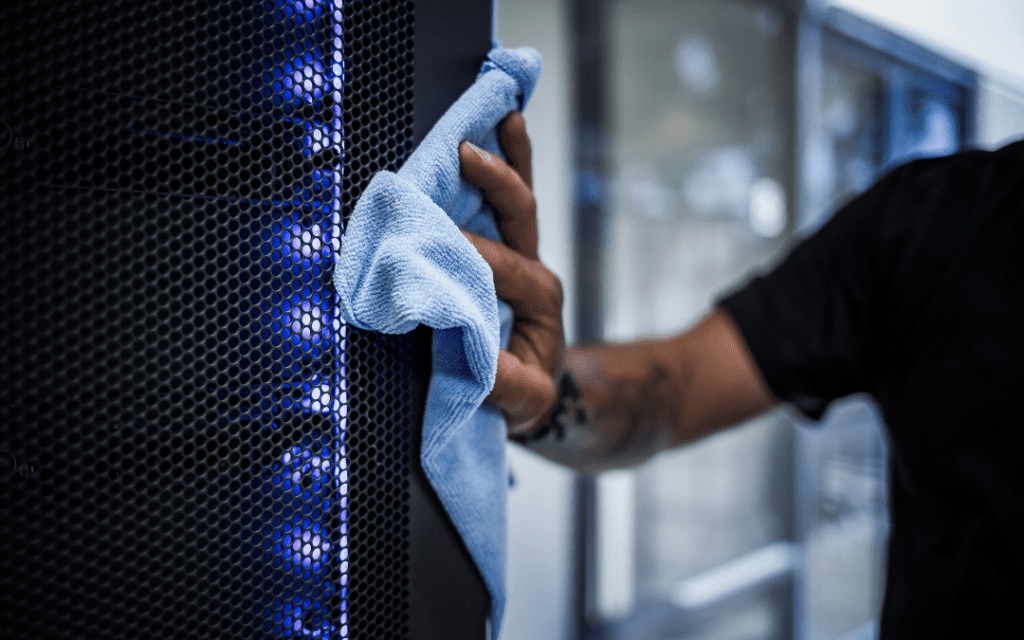
The 6-step disaster recovery cleaning process
Every recovery effort is shaped by the specific event, but the underlying process follows the same six stages from arrival to sign-off.
1. Site safety and damage assessment
Before anyone touches a server rack, the facility needs a walkthrough to identify electrical hazards, structural issues, standing water, and air quality risks. This step also produces the documentation insurers will require later, so it pays to be thorough.
2. Power and equipment isolation
Affected equipment is isolated and, where possible, de-energized. Generators are inspected, with filters checked for contaminants, fuel supply confirmed, and runtime calculated against expected restoration time. Skipping this step is one of the most common ways recovery efforts go sideways.
3. Gross contamination removal
Standing water is extracted, large debris is removed, and HEPA-filtered vacuums begin pulling soot or particulate off horizontal surfaces. This stage uses ESD-safe tools to protect any hardware that remains live, and it sets the stage for the precision work that follows.
4. Precision cleaning of critical surfaces
This is where specialized data center cleaning matters most. Crews focus on:
- Raised floors and subfloor plenums, where debris disrupts airflow and cooling
- Equipment surfaces, including racks, cabinets, switches, and exterior chassis
- Overhead infrastructure, including cable trays, ceiling tiles, and structural components
- Air handlers and return paths, to prevent recontamination once HVAC restarts
The order matters. Cleaning overhead surfaces before raised floors prevents debris from being knocked down onto a freshly cleaned plenum, and following the engineered airflow path during cleaning reduces the chance of cross-contamination between zones.
5. Environmental sampling and reporting
Particle counts, surface samples, and (when relevant) microbial testing confirm the facility meets cleanliness thresholds before equipment is re-energized. This documentation supports both insurance claims and compliance audits, which is why it’s worth investing in even when the visible cleanup looks complete.
6. Subfloor sealing, ESD restoration, and sign-off
Subfloor encapsulation prevents future particulate migration. Anti-static floor finishes are reapplied. A final walkthrough documents the restored state and gives operations the green light to bring equipment back online.
Together, these six stages turn what could be a chaotic scramble into a repeatable, defensible process. The facilities that recover fastest are usually the ones that have rehearsed this sequence before they ever need it.
What does disaster recovery cleaning typically cost?
Costs vary dramatically based on facility size, contamination type, and how quickly cleanup begins.
Direct cleaning costs are usually a small fraction of the total recovery picture once you factor in equipment replacement, downtime, and SLA penalties, which is why most operators prioritize speed-to-clean over cost optimization.
Three factors move the price most:
- Contamination type. Soot and salt residue cost more to remove than dry particulate.
- Square footage and rack density. Hyperscale and AI facilities require more crew hours per square foot due to equipment density.
- Response time. Corrosive contamination becomes more expensive the longer it sits.
The takeaway for most operators is that the cheapest recovery is the one that starts fastest. A vendor on retainer can typically mobilize within 24 hours, which often saves more in avoided corrosion damage than the retainer itself costs over the course of a year.
Insurance: what to know before you file a claim
Most data center operators draw on three policies during recovery: commercial property insurance for structural damage and equipment, business interruption insurance for lost revenue during downtime, and flood insurance, which is a separate policy in most regions including FEMA flood zones in California, Arizona, Texas, and the Gulf Coast.
Two practical tips consistently save claims headaches.
First, document everything before cleanup begins. That means photos, video, particle count readings, water depth, and soot patterns. Adjusters need this baseline, and once cleanup starts you can’t recreate it.
Second, use a cleaning vendor familiar with insurance documentation. A vendor who provides itemized reports, environmental sampling data, and chain-of-custody records makes claims approval significantly faster, and that speed translates directly into shorter business interruption claims.
Disaster recovery cleaning for AI facilities and hyperscale environments
The shift to AI workloads has changed the recovery equation. GPU-dense racks run hotter, draw more power, and are more sensitive to airflow disruption than traditional CPU servers. A small amount of subfloor debris that a legacy data center could tolerate will throttle an AI training cluster.
Recovery for these environments now requires:
- Faster response windows, often 24-hour mobilization
- ESD-safe protocols throughout, since these environments are unforgiving of static discharge
- Environmental sampling tied to specific aisle and rack zones, not just facility averages
- Coordination with on-site network operations to clean live zones without service interruption
Operators of AI and hyperscale facilities increasingly write these requirements directly into their cleaning vendor contracts, rather than treating them as exceptions during an emergency. That shift reflects a broader move toward treating cleaning as part of operational risk management rather than a reactive expense.
Cybersecurity during physical recovery
Disaster events create cybersecurity exposure that’s easy to overlook when uptime is the priority. Crews are unfamiliar, badge systems may be in degraded mode, and IT teams are focused on getting systems back online rather than monitoring for intrusion attempts.
The recovery period should be treated as elevated risk, which means maintaining badge access controls even during cleanup, logging every vendor entering and leaving the white space, running heightened intrusion detection on systems coming back online, and verifying backup integrity before restoring from any off-site copy.
The pattern most often exploited during recovery is social engineering, with bad actors posing as cleanup contractors or insurance adjusters to get physical or network access. Pre-vetting your recovery vendors and maintaining a known-contact list closes that gap before the event.

How to prepare before a disaster happens
The single highest-leverage action is pre-contracting a data center cleaning partner with disaster recovery capability. After an event, every facility in the region is calling the same handful of qualified vendors, and pre-existing relationships move you to the front of the queue.
Beyond that, a few readiness practices pay for themselves:
- Maintain current backups with verified restore tests, ideally quarterly
- Schedule routine data center cleaning, since facilities on a regular cleaning cadence recover faster because baseline contamination is already low
- Document your facility with floor plans, equipment inventories, and cleanliness baselines that give recovery crews a starting reference
- Run a tabletop disaster drill annually with your facility, IT, and vendor teams
None of these steps are dramatic on their own, but together they compress recovery time from weeks to days when an event actually happens. That compression is what separates operators who absorb a disaster as a manageable disruption from those who experience it as an existential event.
Get a disaster recovery cleaning quote from Pegasus
Pegasus provides specialized data center cleaning and disaster recovery services for enterprise data centers, colocation facilities, hyperscale environments, AI facilities, network operations centers, and telecommunications sites across San Diego, Long Beach, Phoenix, Fremont, Denver, and major technology markets nationwide.
Our services include precision cleaning, raised floor and subfloor cleaning, equipment surface cleaning, overhead and high-surface cleaning, ESD-safe floor care, environmental sampling and reporting, and 24/7 disaster recovery response.
Get your instant quote or explore our data center cleaning services to learn more about how we protect critical infrastructure.
Pegasus has been protecting mission-critical environments since 1992, with offices in San Diego, Long Beach, Phoenix, Fremont, and Denver. Headquarters: 7966 Arjons Dr., Suite A/B, San Diego, CA 92126. Phone: 858.444.2290.
Frequently asked questions: Data Center Disaster Recovery Cleaning
How long does disaster recovery cleaning take?
Smaller server rooms can be cleaned and certified in 2 to 5 days. Hyperscale and AI facilities typically take 1 to 3 weeks depending on contamination type and how much equipment can be cleaned in place versus requiring removal.
Can servers be cleaned while running?
In many cases, yes. ESD-safe cleaning protocols allow specialists to clean around live equipment in non-critical zones. Equipment in the direct contamination path usually needs to be powered down for surface cleaning.
Does insurance cover disaster recovery cleaning?
Most commercial property and business interruption policies cover specialized cleaning when it’s tied to a covered event. Flood damage typically requires a separate flood policy. Always confirm with your carrier before work begins.
What’s the difference between disaster recovery cleaning and routine data center cleaning?
Routine cleaning maintains a baseline cleanliness standard. Disaster recovery cleaning addresses elevated contamination from a specific event and includes environmental sampling, documentation, and remediation steps that routine work doesn’t.
Do we need to evacuate the data center during cleaning?
Not usually. Most disaster recovery work is staged zone-by-zone so unaffected operations can continue.
What certifications should a data center cleaning vendor have?
Look for vendors familiar with ISO 14644-1 cleanroom standards, ESD protocols (ANSI/ESD S20.20), and OSHA hazmat training for fire and flood remediation.